
CISGUARD
Critical Infrastructures Guardian
Project Code:
21022
Leader:
SINUTA S.A. [SI]
Promoters
- Synopsis Planet - Advance Engineering, Lda [SP]
- Swatter Company, Lda. [SC]
- Beyond Vision - Sistemas Móveis Autónomos de Realidade Aumentada, Lda [BV]
- Instituto de Telecomunicações [IT]
- Ministério da Defesa Nacional - Marinha (Centro de Investigação Naval) [CINAV]
- Estado Maior do Exército (Centro de Investigação e Inovação da Academia Militar) [CINAMIL]
Project Duration
01/11/2025 - 31/10/2028 (36 months)
Total Cost
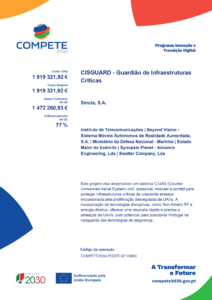
1.919.321,92€
Eligible Cost
1.919.321,92€
UE Financial Support
1.472.260,93€
UE Co-Finance
76.71%
Operation Sheet
EXISTING C-UAS
| Company | Product | Country | Reference |
|---|---|---|---|
| Lookheed Martin | Morfius | EUA | Ref. |
| General Dynamics | Dedrone | EUA | Ref. |
| MSI-Defence Systems | Terrahawk Paladin | UK | Ref. |
| Thales Group | EagleShield | France | Ref. |
| Rafael Advanced Defense Systems | Drone Dome | Israel | Ref. |
| INDRA | Crow | Spain | Ref. |
| Leonardo | FalconShield | Italy | Ref. |
| Rheinmetall AG | Drone Defence Toolbox | Germany | Ref. |
This analyses revealed a diverse range of solutions to threat detection, target classification, tracing and threat mitigation (countermeasures). In the detection and trace phase, majority of the manufacturers present a combination of radar technologies and passive image sensing technologies. On the other hand, few incorporate acoustic sensors, or at least, their presence in their specifications is not clear. Active optic systems like LiDAR, used in other applications (e.g. autonomous robotics and topography), normally aren’t included in C-UAS technologies, despite their capacity to rapidly provide target range, azimuth and target elevation.
The search for C-UAS tailor-made solutions for the civil sector is rapidly growing. These solutions should be more accessible, easy to use and operate, apart from attending to the specific necessities of each critical infrastructure. Apart from technical and financial barriers, other factors push this development necessity of new civil C-UAS systems, for example:
- Legal framework: The legislation about the use of UAVs and C-UAS system is still incipient in a lot of countries, which create uncertainties and complicates the implementation of effective solutions.
- Risks of Interference: The possibility of electromagnetic interference in adjacent systems, like communications and navigation, demand C-UAS solutions carefully projected to minimize these risks.
- Ethic Questions: The use of C-UAS technologies brings ethic questions about privacy, vigilance and strength use, which need to be addressed in a transparent and responsible way.
CISGUARD PROPOSAL
The CISGUARD project proposes to overcome these challenges previously listed by developing a civil C-UAS system low-cost, modular, portable and highly effective, that takes in account the compliance of the current normative national framework and European in protection of Critical Infrastructures. In order to evaluate the quality of the current project, a few of the important features are shown below.
Reduction of sell and maintenance costs
Current similar systems to CISGUARD are evaluated for costs superior to 1M€ and maintenance year tax around 75% of the purchase value. CISGUARD intends to reduce both selling price and maintenance cost by 50% and 80% respectively. (20% relative importance)
National production, European product chain
Currently it’s not produced in Portugal these types of technologies and existing systems at a European level depend strongly on Asian and American supply chains, making the systems not adapt to European legislation. The objective of CISGUARD is that 75% of the components should be exclusively provided by the European market, turning it into a European product and regulated exclusively with its politics.(10% relative importance)
Development of a rangefinder with Sensor of 4 quadrants and microchip laser technology
Non existent in current market. The goal is to incorporate in the issuing part of the rangefinder a microchip laser technology which will allow tracking of UAVs. This ragefinder is in it's final development phase in Synopsis Planet. (20% relative importance)
Innovation in detection, tracking and identification algorithms
Existent, but it's in need of optimizations. In consideration of operation conditions of CISGUARD, the goal is to generate a new system apt to proceed in the detection, identification and tracking in the conditions demanded by the data collection and type of information of the various CISGUARD subsystems. (15% relative importance)
Integration of a monitoring spectral system of strategic wake-up with FMCW radar
Exists, but needs optimization. By integrating this system with a FMCW 360º radar to achieve a pre-detection, tracking and identification of UAVs, this combination of technologies will allow to provide the optic system information that can be used for an efficient tracking and a rapid response to threats. (20% relative importance)
Development of countermeasures against UAVs based on wireless energy transmissions
Also exists, but needs optimization. CISGURD’s objective is to integrate Non-Kinetic RF technics and energy directed to developing a UAV countermeasure system. Creation of effective methods of spoofing GPS signal and overcharge electromagnetic solutions that utilize RF signals of high power to deactivate UAVs. (15% relative importance)
SOLUTION
CISGUARD in order to achieve these goals, It was outlined a strategy established in 4 pillars that will drive to the success of this project.
The first pilar is the innovation and technology differentiation of the presented solution. The CISGUARD system will be composed by a combination of 4 subsystems:
- Detection Subsystem
- Precise tracking and detection subsystem
- Countermeasure subsystem
- Monitor Station
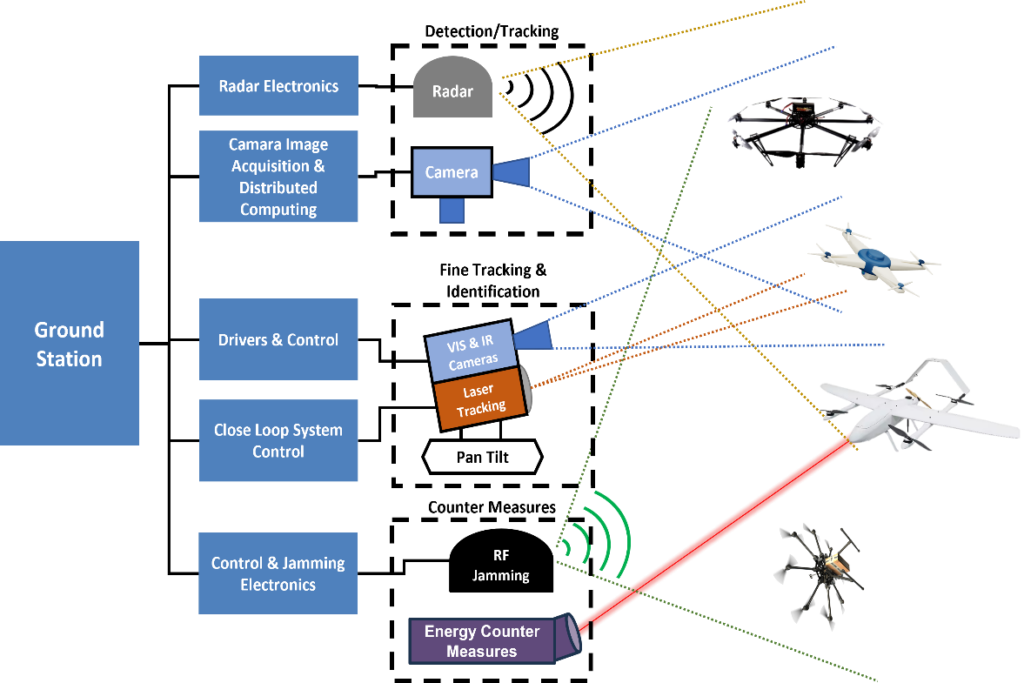
This system presents a combination of various technological innovations and differentiators that makes it stand out in comparison to current commercial systems and it allows it to offer a quick, precise and scalable response to UAVs threats and with a potential of positioning Portugal on the vanguard of security technologies innovation.
Advanced detection system
Combination of radar and visible cameras at long distance (up to 5km) allows for a more effective detection, removing false positives and increasing precision.
Thin tracking with multiple sensors
The system with laser track, combined with zoom cameras, infra-red and a rangefinder offers a highly precise and detailed monitorization of the UAV. The assembly in a pan tilt allows monitoring the target in various directions, granting the effectiveness even in complex maneuvers, controlled dynamically by the innovated integration of a 4-quadrant sensor working in a closed loop.
Detection ability and swarm tracking
The integration of multiple cameras working in the visible and infra-red spectrum, allows a comprehensive and detailed monitorization of the environment.
Versatile countermeasures
The countermeasure system offers 2 options: Radio Frequency(RF) interference to block command and control signals(Jamming), and a system of directed energy via microwaves to damage the electronics of the UAV in cases of Jamming not being effective.
Integration and effectiveness
The assembly of the directed energy system in the same pan tilt of the thin tracking system, alongside with the rangefinder alignment, grants the energy efficiency and minimizes the impact and electromagnetic interference in adjacent systems.
The second pilar concerns the formation of a multidiscipline consortium comprehended by:
is related to the strategy adopted by the consortium to overcome the legal limitations that restrict the use of these systems. For this, this project predicts an exhaustive survey during the entire project’s duration of the legislation and the Portuguese and European normative system. This task will allow to mark the development’s requirements so that the technology can meet the legal framework uses of C-UAS. Apart from that, the consortium will integrate in the organization structure of the project an advisory council constituted by representatives of the national authorities( Autoridade Aeronáutica Nacional, Autoridade Nacional de Emergência e Proteção Civil e a Autoridade Marítima Nacional and some of the main national operators of Critical Infrastructures (GALP, REN).
contributing to the project’s success is an economic value strategy of CISGUARD based on the system’s low cost, diversification of recipe fonts and potentiality of technology abilities of companies from the consortium.
| # | Activity Name | Promotor | Status |
|---|---|---|---|
| 1 | Management | SI | |
| 2 | Dissemenition of the Project and Result's Disclosure | SI | |
| 3 | Technical-Scientific, Business and Industrialization Analysis | IT | |
| 4 | System's Engineering and Use Cases | SP | |
| 5 | Development of the Detection and Radar Tracking Subsystem | IT | |
| 6 | Development of the Detection and Optic Tracking Subsystem | SP | |
| 7 | Development of the Countermeasure - Non-Kinetic RF and Direct Energy - WPT Subsystem | IT | |
| 8 | Development and Algorithm Suitability | SP | |
| 9 | Integration of Subsystems and Developmentof the Monitorization and Control Station | SI | |
| 10 | System's Demonstration | SP |
| # | Milestone Name | Month | Status |
|---|---|---|---|
| M1.1 | Project start | 0 | Done |
| M1.2 | Final Revision and Project Closure | 36 | |
| M2.1 | Definition of General System Architecture | 7 | |
| M2.2 | Validation of Subsystem's Drawings | 17 | |
| M2.3 | Validation of System's Drawing | 24 | |
| M2.4 | Validation of System's Tests | 29 | |
| M3.1 | System's Demonstration | 35 |
| # | Deliverable Name | Promotor | Publicity | Status |
|---|---|---|---|---|
| E1.1 | Project's Management report | SI | Confidential | |
| E1.2 | Quality and Security Plan | SI | Confidential | |
| E1.3 | Revision of the Quality and Security Plan (E1.2) | SI | Confidential | |
| E1.4 | Intelectual Propriety Management Plan | SI | Confidential | |
| E1.5 | Quality and Security Report | SI | Confidential | |
| E2.1 | Website | SI | Public | |
| E2.2 | Comunication and Disclosure Plan | SI | Public | |
| E2.3 | Project's Dissemination Dossier | SI | Public | |
| E2.4 | Compilation of scientific publications of the Project | IT | Public | |
| E3.1 | State of the Art Report | IT | Public | |
| E3.2 | Summary of the aplicable legislation and respective legal requirements | SI | Public | |
| E3.3 | Revision of the Summary of the aplicable legislation and respective legal requirements (E3.2) | SI | Public | |
| E3.4 | Business Plan | SI | Confidential | |
| E3.5 | Industrialization Plan | SI | Confidential | |
| E4.1 | General Architecture of the system | SP | Confidential | |
| E4.2 | Definition of the Use Cases | CINAMIL | Public | |
| E4.3 | System's Specifications and Requirements | IT | Confidential | |
| E4.4 | Revision of the System's Specifications and Requirements (E4.3) | IT | Confidential | |
| E4.5 | Document of the Interface Controls | SI | Confidential | |
| E4.6 | Revision of the Document of the Interface Controls (E4.5) | SI | Confidential | |
| E4.7 | Revision of the Document of the Interface Controls (E4.6) | SI | Confidential | |
| E4.8 | Plans of the Manufacturing and Tests of the Subsystems | SI | Confidential | |
| E5.1 | Technical report of the Radar Tracking and detection subsystem's drawing | IT | Confidential | |
| E5.2 | Report of the Radar Tracking and detection subsystem's Tests | IT | Confidential | |
| E5.3 | Radar Tracking and Detection subsystem's Prototype | IT | Confidential | |
| E6.1 | Technical Report of the Optic Tracking and detection subsystem's drawing | SP | Confidential | |
| E6.2 | Report of the Optic Tracking and detection subsystem's Tests | SP | Confidential | |
| E6.3 | Optic Tracking and detection subsystem's Prototype | SP | Confidential | |
| E7.1 | Technical Report of the Countermeasure Subsystem's Drawing | IT | Confidential | |
| E7.2 | Report of the Countermeasure Subsystem's Tests | IT | Confidential | |
| E7.3 | Countermeasure Subsystem's Prototype | IT | Confidential | |
| E8.1 | Description of the Developed Algorithms | SP | Confidential | |
| E8.2 | Algorithms' Test Results | SP | Confidential | |
| E9.1 | Plan of the Production, Integration and Tests of the System | SI | Confidential | |
| E9.2 | Report of the System's Laboratory Tests | SP | Confidential | |
| E10.1 | Final Report of the CISGUARD system's Tests | SP | Confidential | |
| E10.2 | Final Report | SI | Confidential | |
| E10.3 | Lessons learned and Future Developments | SI | Public | |
| E10.4 | CISGUARD system | SI | Public |
PUBLICATIONS
PROMOTERS









(+351) 234 840 280

Rua do Rio Gonde, nº 4 Lote 3 Eco-Parque Empresarial 3860-529 Estarreja PORTUGAL

rd@sinutagroup.com